 |
 |
 |
 |
 |
|
 |
|
 |
|||||||
|
|
|
|
|
|
|
|
|
|||||||
Paul Gosselin
 Creationists
are not a uniform group. Varying views on different subjects may be found.
For example, as regards mechanisms that might have provoked the Flood described
in the book of Genesis, various explanations have been proposed. In general,
creationists assume that the Flood covered all the earth and that a great
number of species (of plants and animals) disappeared then or in the period
that immediately following this event. All assert that the majority of sedimentary
rock covering the Earth's surface was deposited during this event and that
the geological strata represent not distinct geological periods, but different
ecological environments, populated by different organisms. Obviously, since
marine organisms did not get on the Ark, a certain number of them disappeared
in the course of the Flood. For example, in general dinosaurs are considered
not to have disappeared at the moment of the Flood, but in the centuries that
followed and this being due to major climate and environment changes caused
by the Flood that have affected both their food supplies and metabolism.
Creationists
are not a uniform group. Varying views on different subjects may be found.
For example, as regards mechanisms that might have provoked the Flood described
in the book of Genesis, various explanations have been proposed. In general,
creationists assume that the Flood covered all the earth and that a great
number of species (of plants and animals) disappeared then or in the period
that immediately following this event. All assert that the majority of sedimentary
rock covering the Earth's surface was deposited during this event and that
the geological strata represent not distinct geological periods, but different
ecological environments, populated by different organisms. Obviously, since
marine organisms did not get on the Ark, a certain number of them disappeared
in the course of the Flood. For example, in general dinosaurs are considered
not to have disappeared at the moment of the Flood, but in the centuries that
followed and this being due to major climate and environment changes caused
by the Flood that have affected both their food supplies and metabolism.
This note takes a look at the Hydroplate theory, proposed by Walt Brown, (PhD in Mechanical Engineering MIT). In the course of 21 years of service in the American aviation Brown has been director of Benet Research, Development, and Engineering Labs at Albany, New York, tenured associate professor at the U.S. Air Forces Academy and Director of Science and Technology Studies at the Air War College.
For a long time Brown was an evolutionist, but after years of study he became convinced the validity of the Creation thesis and of the concept of a global Flood. The Hydroplate theory asserts that before the Flood, approximately 50% of the water in present oceans was contained in underground reservoirs, a huge underground body of water about 10miles under the surface. One huge supercontinent would have covered the surface of the Earth, including some small mountains and small oceans. The Hydroplate theory derives for the most part from a little known verse in Genesis (Gen 7:11). The Bible gives two sources for waters of the Flood. "In the six hundredth year of Noah's life, in the second month, the seventeenth day of the month, the same day were all the fountains of the great deep broken up, and the windows of heaven were opened." (Gen 7:11). The Hydroplate theory therefore puts the fountains of the great deep 16 km below the Earth's surface. Though this theory postulates pre-Flood conditions that differ quite significantly from those currently prevailing, such conditions are actually just what is required to provide a plausible explanation for a world-wide Flood. For example, if one postulates a pre-Flood world where conditions were to a great extent the same as present, then even a melt-down of all the Earths polar ice-caps would not provide enough water to cover the entire surface of the Earth. Many high plateau areas and mountain ranges would still be above water.
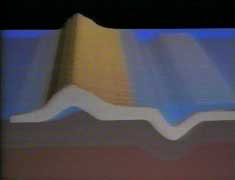
Further study of the biblical support for hydroplate theory is available on Brown's web site. The file offered here (see below) provides access to a computer simulation which gives an idea of the violence of the Flood described in the book of the Genesis. Hydroplate theory provides an interesting perspective on how mountains and the deep ocean trenches were formed. It postulates that the Flood was initially provoked by a rain of meteorites. This animation is drawn from a TV documentary entitled "The Search for Noah's Ark". Though Walt Brown's concept has morphed somewhat over the years to try to address the geometry of how a shell of granite crust could be redistributed into what we see today. Here is a (no doubt incomplete) nutshell view of his perspective:
1) A shell of granite surrounded the Earth, resting on a layer of water under great pressure. Below the water was besalt rock (or whatever is pre-melted oceanic rock).
2) The shell ruptured a shot out water alone a line that we now call the mid-oceanic ridge (a feature which must be explained in any Flood model)
3) This rupture phase widened to about 800 miles width shooting up rocks, sediments and water (some into space, giving birth to comets, a whole other topic)
4) The removed crust created a vacuum to be filled. This caused the Mantle to move to fill the vacuum. This movement began in the Atlantic.
5) The move towards the Atlantic caused the Mantle to start a chain event that went through the Mantle sucking down the Pacific as the Atlantic rose.
6) This sucking down of the Pacific caused the Pacific plate to be sucked into the Earth (already detached along the mid-oceanic ridge). Also created the trenches, extensive volcanic activity and Ring of Fire.
7) As the Atlantic rose the plates started to slide away from the rising ridge in both directions in the Atlantic.
8) As the moving plates slowed and piled up on themselves, they thickened and created the present continents which are about 3 times as thick as the original granite shell
Others approaches to the Flood.
The oldest model for the Flood proposed by modern creationists is the
Hydraulic model advanced by Mr. Henry M. Morris and John Whitcomb in
their book The
Genesis Flood. This approach implies a universal Flood with significant
volcanic activity. The hydraulic model also involves a tropical antediluvian
climate, caused by a vapour canopy above the atmosphere. Numerous fossils
found today in Arctic regions attest to the existence of a such climate in
past times. For example, metasequoia fossilsare found at Axel
Hieberg in the high Canadian arctic, tropical plants in Antarctic coal
and Iguaunodon footprints in Spitsbergen. Being just 1,300 km from the north
pole, In present times, Spitsbergen can't really be considered an attractive
tropical holiday destination... A vapour canopy is known to exist above the
planet Venus and increases surface temperatures to a great degree.
Another approach to Flood processes is known as Crustal Plate Tectonics theory (or CPT), proposed by John Baumgardner asserts that the Flood involved not only water covering all the Earth's surface, but, at the same time, massive movements of plates of the Earth's crust, possibly provoked by meteorite or comet impacts. One need only to think of the Shoemaker-Levi comet impacts on the planet Jupiter to get a general idea of the energy produced by such events. CPT implies also a form of continental drift, but on a timescale far shorter than that accepted by evolutionists. CPT does not accept hydroplates, nor the immense water reserves under the Earth's crustal. Others creationists have explored extreme weather phenomena such as hypercanes and their extraordinary erosional effects.
Issues dealt with by the animation.
This QuickTime file includes a brief explanation and computer simulation of the Hydroplate theory and a description of the physical events involved in the Flood as described in the book of the Genesis. One can obtain further information at the Center for Scientific Creation web site. See also The Hydro-Plate Theory and The Great Flood, by Walt Brown (October 31st, 2010).
 |
|
Language: anglais Format: 240 X 180 pixels (Quicktime, .mov) click on image above to download Audio/video quality: average A copy is available on YouTube |