 |
 |
 |
 |
 |
|
 |
|
 |
|||||||
|
|
|
|
|
|
|
|
|
|||||||
 Paul
Gosselin (June 2004)
Paul
Gosselin (June 2004)
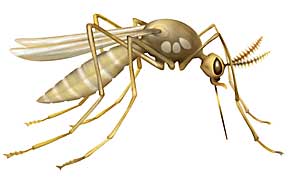
In Canada hordes of mosquitoes, black flies and horse flies which, in the summer, take turns making life out of doors difficult, if not miserable. In the far north, the situation can be worse than unpleasant as Davidson and Rugg, in The Complete Wilderness Paddler (1975/83 Vintage Books New York) attest:
"Bugs. Believe us, the itch to head north is nothing compared with
the itch of being there. If you're a veteran wilderness paddler, you know
what we mean; if you're not, listen to Horace Kephart, who wrote a guidebook
in 1916. "In Alaska", he says,
All animals leave to the snow-line as soon as the mosquito pest appears,
but the enemy follows them even to the mountain tops above timber-line.
Deer and moose are killed by mosquitoes, which settle upon them in such
amazing swarms that the unfortunate beasts succumb from literally having
the blood sucked out of their bodies. Bears are driven frantic, are totally
blinded, mire in the mud, and starve to death. Animals that survive have
their flesh discoloured all through, and even their marrow is reduced to
the consistency of blood and water. The men who penetrate such regions are
not the kind that would allow toil or privation to break their spirit, but
they become so unstrung... that they become savage, desperate, and sometimes
even weep in sheer helpless anger. It is a subject to be taken seriously."
(p. 188)
From a Christian or creationist point of view one might envisage the question "Is God some sort of sadist taking pleasure in inventing convoluted torments for his children ??" If that is not the case, then why create such irritating and perverse critters ??
Point 1: (VERY IMPORTANT) The three opening chapters in Genesis tell us
that the biological world was originally created perfect in every way. But
then something happened and that original perfect order was destroyed and
perverted. Since then we live in a Fallen world and none of the organisms we see today are no longer function and live as they used to. There is evil and disorder in the biological world. Organisms of course may be degraded in longevity, in capabilities, in size, etc.
Point 2: Considering point 1, it may be posited that parasite - host relationships may well be degraded forms of inter-species relations too, That is, formerly these may have been symbiotic relationships (where BOTH organisms benefited) instead of parasitic relationships as we find them now (where ONLY ONE organism benefits, the other becoming prey).
Point 3: It is possible that animals were created originally with recessive
genetic information to generate defense-attack structures and this information
was switched on after the Fall, either by direct intervention, by environmental
triggers as part of the curse, or by natural processes of recombination
and selection.
Point 4: It is possible that God directly and supernaturally altered the
DNA of some (or all) plants, animals, & etc. at the time of the curse
Examples of parasitic relations which one can think of: viruses, mosquitoes, tape worms, etc.
The American geneticist Kevin Anderson notes (2004): "Parasitic bacteria can fairly easily be understood in terms of "loss of function." As the ability of the organism became genetically depleted, it was forced to depend upon other biological systems to greater and greater degree, until it finally became fully parasitic, hence pathogenic to the host. Such transformation may apply to non-microorganisms also."
Because Intelligent Design proponents attempt to avoid any specifically "religious issues", this leaves them without an answer to the question of evil or dysfunctionality in the biological world.. But if one does take a second look at the Christian doctrine of the Fall, then a rational answer to this question can be had. But even among many Christians, who have compromised with the dominant evolutionary mythology, the Fall is considered a shadowy, "poetic" event, serving only to provide us with "moral teachings". For the most part it is ignored and as a result when faced with the issue of evil in the biological world the best most Christians can do is mumble meaningless drivel about how "God's ways are mysterious to us". If the Fall is taken as a historical environmental and cosmological event, then there is a rational explanation to be found for evil, decay and disorder in the biological world.
Of course Intelligent Design proponents cannot get into such matters without being accused of introducing "religion" into science and being called "stealth creationists". This is of course nonsense as if you look at the origins debate, religion is already found in the science classrooms as evolution, if you look at it from my field of specialisation, anthropology of religion, is an origins myth. I'm well aware this is not commonly held view, but it is quite defensible from the point of view of Social Anthropology as well as viewed from the Philosophy of Science.
Possible implications for pharmaceuticals:
If we take the mosquito for example, it is known to inject an anticoagulant
substance before beginning to extract the host's blood. If we look at the
present host - mosquito relationship in the perspective that it was formerly
symbiotic, then there is a possibility that one of the substances injected
would have been beneficial to it's host. Perhaps the anticoagulant or perhaps
some other unknown substance. There is then the possibility that an unknown
substance injected by the mosquito (perhaps the anticoagulant isn't the only
substance injected) may be of some use to men. As an example, an article by
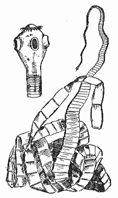
Matt Kaplan, in the July issue of New Scientist explores how certain parasitic
worms could be used as therapy to combat allergies in humans.
 |
flat worm
|
Pitfalls and Traps for this line of inquiry.
There are plenty of traps to fall into however in following such a line of
thought. On has to consider that not all present host - parasite relationships
may represent former symbiotic relationships. That is, before the Fall mosquitoes
may not have targeted humans, in which case searching for substances beneficial
to humans in mosquitoes may be futile. In other cases there may be a possibility
(from a biblical perspective) of determining if there was a previous symbiotic
relationship or not. For example, in the case of worms picked up by humans
after eating unproperly cooked pork. We don't even have to back up to the
Fall to figure out this one as the Bible tells us that predator - prey relations
appeared after the Flood (Man became a predator -> Gen. 9: 2-4). From biblical
information then, we would know that these worms, picked up by humans eating
pork, introduced an unintended relationship. We could then establish that
this particular predator - prey relationship is then accidental (unintended
in the original creation) and so looking for beneficial substances for humans
in the pork worms is futile. These worms, however, may have been formerly
beneficial to herbivores (such as pigs or sheep). One may also speculate that
before the Flood one of the forms of wickedness found among the antediluvians
may have been bestiality, which would have introduced parasitic organisms
to hosts they were never supposed to encounter. This in turn would explain
in part the forbidding of sex between humans and other species[1]
in Leviticus 20: 15.
Another line of thought about pitfalls for this type of research is that even if we have identified a proper parasite - host relationship (previously symbiotic[2]), parasitic organisms, being fallen creatures too, the substances presently injected will not necessarily be identical to those formerly injected (by the mosquito for example). One would have to start by doing an inventory of the various substances presently injected and then look for chemical "cousins" (perhaps larger molecules or molecules related in some way to those presently found ?) in order to find the original beneficial substance. I would not expect discovering beneficial substances this way to be a easy process. There may be too many changes in the vector organism (presently a parasite) itself (metabolism, chemical processes, etc.) and it's relations with other organisms to enable us to identify the original beneficial substances. There is an additional problem. The host organism's metabolism may no longer be capable of using the original beneficial substance (even if we did manage to find it). Nonetheless, creationist pharmaceutical researchers may well find this perspective useful in exploring our world for new medicines for humans or for veterinary purposes. Perhaps someone will "get lucky".
Further speculation
Reflecting on symbiotic relations in an unfallen world, the creationist David
Bump throws out the following ideas:
Some people say that we were created with perfect bodies, and that that means that they would last forever by purely self-contained mechanisms and repair systems. I'm not so sure -- I think it is possible that our bodies were perfectly designed to fit in and be a part of the perfect original environment, and that may have included receiving "tune-ups" and "check-ups" via nanobots (very very tiny robots) otherwise known as micro-organisms (and viruses), injected by an occasional visit from one of these little blood-suckers. Some of the chemicals they use, such as anticoagulants, might also have been helpful.
Here is a comment from engineer Doug Harold:
The Bible clearly states that He altered the serpent and clearly implies that He either altered existing plants or created altogether new ones by introducing thorns and thistles. So what are these thorns and thistles? They are defensive structures. Thus, I do not think it's a stretch to suggest that God 'may' have initiated the entire predator-prey dynamic by supernaturally altering the DNA of many plants and animals at that time. I see no reason to think that the sabre tooth cat had those enormous canines (for example) in the original creation in the Garden. Nor to I see any reason to think that he had latent genetic code for them in the original creation, or that that he "devolved" the code for those features as a result of the fall.
Though it is true that both at the Fall and after the Flood we see new traits appearing the biological world, I would beg to differ with Harold here that modification of phenotypes (visible biological structures) demands changes in the gene pool, that is alteration of the original gene pools. We are just discovering what all that DNA means and it is possible that some of the so-called "Junk-Genes" actually code for information that may be activated when needed. Though Scriptures do inform us that changes to biological organisms have occurred in the past, we are not informed about the specific mechanisms involved. On the matter of symbiosis, Jonathan Bartlett adds:
One thing to keep in mind is that it is indeed possible from a Creationary perspective for a symbiosis to have evolved. Darwinists can't do this because of the multiple mechanisms -- randomness can't account for its generation. However, in a design framework, the creation of symbiosis is not problematic -- it just means that the mechanisms to establish a symbiosis was precoded into animals. The specific symbiosis that occur are probably due to both the environment and the other organisms available for symbiosis. But the capability to establish numerous types of symbiosis is probably pre-coded into organisms.
After the original Creation, Genesis seems to mention genetic changes to living organisms on two occasions (though another possibility is switching on dormant genes deep in the so-called "junk DNA"). Once at the Fall itself (thorns are mentioned as new) and also immediately after the Flood when "carnivory" (eating meat) is mentioned for the first time as well as the fact that animals would now fear humans from then on (Gen 9: 2-3). This would imply that before the Flood there was no such thing as a "wild animal". It is also implied by prophets discussing the restoration of all things that predation is actually an abnormal state of affairs, which will eventually be put an end to when things will be returned to their normal state in Messianic Times:
The wolf and the lamb shall feed together, and the lion shall eat straw like the bullock: and dust shall be the serpent's meat. They shall not hurt nor destroy in all my holy mountain, saith the LORD. (Is 65: 25)
But let's get back to "carnivory" after the Flood. One hypothesis I've heard is that certain plant foods available before the Flood became extinct and thus many organisms had to become carnivores to get their allotment of protein. On the other hand, perhaps carnivory was not due to species of plants going extinct, but rather ecosystems disappearing. For example, in our world Clover lives in a symbiotic relation with a particular bacteria species (called Bacillus radicicola) which produces nitrogen which clover needs. Now suppose that the bacteria had a genetic modification, which no longer enabled it to produce a certain enzyme essential to its relation with clover. Perhaps clover and the bacteria would still exist, but repercussions to the biosphere would still be important nevertheless...
Perhaps after the Flood similar symbiotic inter-species relationships as
well as ecosystems were destroyed, and as a result many animals had to change
their feeding habits. When this change occurred, they were not necessarily
genetically modified, but perhaps this environmental change was a trigger
to switch on what evolutionists still call "Junk DNA" allowing these
animals (now carnivores) to adapt to this new situation and perhaps switch
on a "new" phenotype (that is, not previously observed).
Post-Scriptum: On reading this note a friend of mine with a background in microbiology and doing cardiac research commented that one would have to have some explanation for immunological systems in humans (and other organisms) seeing that (in his view) originally there wouldn't have been any need for immunological systems at all as everything would have been perfect to begin with.
While it is quite true that from a Biblical point of view everything would have been perfect to begin with, I think it is quite logical to assume that in the same way that the Creator had foreseen the possibility of the Fall and already thought of the possibility of our needing a Saviour, He had also foreseen the physical consequences of the Fall and provided organisms with the genetics for immunological systems that could kick in if the need arose. In engineering terms this is called "overdesign" and provides a mechanism with back-up systems in case of "out of the ordinary" circumstances. I don't think this requires any further explanation.
 |
the wasp and its parasite |
[1] - Though there may be reasons other than biological for this prohibition.
[2]- Ex. Supposing the mosquito's original
target was indeed humans.
Gurney, Robert (2009) What about parasites? Creation vol. 31 (3):34–37 June
Kaplan, Matt (2009) Just what the doctor ordered? pp. 42-45 New Scientist 11 July vol. 203 no. 2716
Tomkins, Jeffrey, Ph.D (2014) Decoding Snake-Venom Origins. ICR Sept.
Yong, Ed (2015) Microbiology:
Here's looking at you, squid: Margaret McFall-Ngai has dissected the relationship
between a beautiful squid and its live-in bacteria — and found lessons
for microbiome research on the way. Nataure Jan. [discusses a case of
bacteria - squid symbiosis]