 |
 |
 |
 |
 |
|
 |
|
 |
|||||||
|
|
|
|
|
|
|
|
|
|||||||
 Review by Paul Gosselin (29/9/2026)
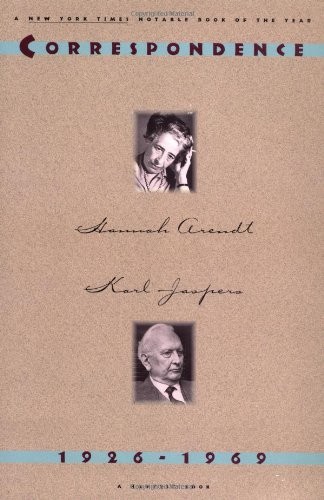
This (1992) book covers letters exchanged between the political scientist Hannah Arendt and Existential philosopher Karl Jaspers over a slightly more than a 40 period, beginning in 1926 to 1969. During World War II, no letters were exchanged between Arendt and Jaspers as at that time Jaspers was living Nazi Germany and Arendt in the United States. Even if mail could have allowed between nations at war, in any case both Allied and Nazi authorities would have regarded such an exchange of letters as suspect and potential spying... It is an open secret that in the 1920s Arendt was the lover of the German philosopher Martin Heidegger, a card-carrying Nazi Party member and forerunner of existentialism and postmodern thinking.
I was rather surprised that Arendt's first publication was a thesis on Love in St-Augustine. Can't figure out what a secular Jew is doing putting in so much time on a famous Christian theologian... But seeing Augustine was much influenced by neo-Platonism, there may be a philosophical angle on this.
But the mind-boggling thing to me is that there is NOTHING in this correspondence about their first impressions regarding what the Nazis did to Jews during the Final Solution. Yet Arendt was a (very secular) Jew and Jaspers had married a Jew. This would have been a personal issue for both of them. Yet there is not a word in their correspondence about this. Early on in the Nazi period Arendt had fled Germany to France and later fled to the US. As a result during most of the war she was living in the US.
My first impression that censorship during the war could have been a factor explaining this silence, but when the war was over, military journalists were probably the first to break the stories about atrocities committed by Nazis against Jews. At a certain point everywhere in the West this became common knowledge, unavoidable common knowledge. During WWII, I'd guess few people in Germany would have really known what the Final Solution was doing[1]. In the West, few people would have been aware of the extent of industrial scale massacres until the war was over. Some Allied military authorities had clearly been informed of the situation during the war, with even requests to bomb railroads going into the concentration camps. There were even requests to bomb the concentration camps themselves, even if this meant killing prisoners, but would at least have had the effect of slowing the genocide. But this was refused, under the pretext that this would “slow the war effort”. Yet when a request to bomb a prison in Amiens France (where Resistance fighters of the French underground were held) was submitted to Allied military authorities then this request was deemed acceptable and went ahead (Operation Jericho). And during this operation, some prisoners were in fact killed by the bombs. I've even heard that certain Allied military authorities were actually (quietly) satisfied with the Final Solution and felt that they should leave the Nazis deal with the Jewish Question (and thus conveniently avoid getting their own hands dirty...).
But regarding Arendt's and Jaspers' reaction to the Final Solution, I have begun to wonder if in fact their reaction may have been one of disbelief and the editors of this volume may have felt it better for Arendt's and Jasper's reputation to drop such comments. This is of course speculation, but it is a fact that during WWII when the Final Solution was ongoing, some Jews had escaped and came back to warn Jewish communities still living in Nazi controlled territories to flee for their lives. In a few cases, the reaction of some Jewish community leaders was disbelief, some even saying that such things could not be true, because after all “Germany was a civilized nation”. While Arendt and Jaspers did not identify much to German politics (during the Nazi period and even post-war), in their correspondence it is clear that they both strongly identified with German culture, philosophy and scientific accomplishments. Thus it is possible that this strong identification as Germans may have been a factor initially in Arendt's and Jasper's rejecting stories about the Holocaust. While of course I may be wrong about the reason for Arendt's and Jasper's silence regarding the Final Solution[2], the fact remains that their silence does raise many questions...
And further into the 1950s correspondence, there is oddly nothing about Israel's recent declaration of independence... Only a vague allusion to “war in Palestine”. Both Arendt and Jaspers seem almost contemptuous[3] of the idea of a nation[4] for Jews. Calling it “Israel” was perhaps an unwelcome reminder of Jew's spiritual inheritance?
Reading between the lines, it would seem to be linked to a distrust of any form of nationalism. Perhaps they feared Jews in Israel would become just as nationalistic as the Nazis had been?? That said, one could factor in that nationalistic concerns had provided the main motive for nations doing NOTHING for Jewish refugees at the 1938 Evian conference. Such behaviour gave Hitler encouragement to go ahead with the Final Solution. In the 1930s, clearly no one cared about the Jews. One 1947 note from Jaspers clarifies his (sometimes paradoxical) views of both Jews and Israel as well as nationalism/globalism (1992: 95)
"Assimilation" [by Jews into the dominant culture] does not strike me as a fundamental issue. However, in the private sphere, there should be no prohibitions against it. You yourself and my wife have settled that through your actions. It would be equally pointless to demand assimilation. But I think it does make sense to fear assimilation, because something priceless would be lost if there were no more Jews, aware of themselves as Jews, in the world. Yet to do or plan anything in this regard or moralize about it strikes me as impossible.
One question is whether the whole Palestine business isn't a total assimilation in a spiritual and intellectual sense. The Jews will remain, but merely as one nation among many and as a very small and unimportant one at that. Will then every last trace of sublimation, of the "chosen people," disappear? That would amount to the loss of Judaism in the husks of people who are still nominally Jews. But that, too, is only a fear. No demands should be made here.
Yes, how right that you keep referring back to the flood. That has to remain our point of orientation. But something arises out of the flood. Life goes on. And we ought at least to find the star that leads us on: something like an idea for a world order, but one that remains influenced by transcendence and does not lead to the flatness of an organization, a rational law for each and every case, to the a-historicity of a presumed paradise. Without the Jews I can't imagine travelling this path, which is a historical one and therefore one bound to history. Hence my worry that the Jewish people could lose their soul in Palestine. Perhaps the solution is to desire Palestine but not go there, because the task is to live among all the peoples of the world, with them and against them as long as they are content to remain peoples and nothing more. This would be a new form of that influence "from afar" which has perhaps always been characteristic of biblical religion. And from that comes the tension and the excitement and the truly infinite nature of the task.
It is rather likely that Arendt shared such views. In response Arendt does says this (1992: 98-99)
The Zionists are the only people that can be taken seriously in this regard. They – and not the proponents of assimilation - are the only ones who no longer believe in the idea of a chosen people. (...) Most important of all is that large segments of the people, not only in Palestine and not only Zionists, reject survival as the goal of the total national life and are prepared to die. That is completely new. Secondly, however, there is a distaste, which is difficult to describe, for the idea of a chosen people. We might say Jews are sick of it. This isn't ideology, as Zionism is, but a mood of the people.
But here's the thing, regarding Jaspers' and Arendt's suspicion of nationalism, in the 1930s, nationalism was heavily steeped in Eugenics and “scientific racism” which proclaimed the “inferiority” of Jews (and Blacks, and others). Yet I saw no evidence in these exchanges between Jaspers and Arendt that they might have recognized that the nationalism of their times had been fatally tainted by Eugenics or beyond that that Eugenics itself was just the logical application of the evolutionary Survival of the Fittest principle to human populations. In the early 20th century, practically all Social Anthropologists (my field of study) promoted "scientific racism”. And of course after WWII, as details of the Final Solution (which was clearly linked with and justified by Eugenics) became widely known, then suddenly Social Anthropologists became benevolent promoters of the “brotherhood of Man”... From that point on, former promoters of “scientific racism” kept their professorships and paychecks, and figured out perhaps it would be best if from that point on they kept their mouths shut about eugenics[5] and all was well...
Nothing to see here. Move on...
Interspersed in the Jaspers-Arendt correspondence are a few letters from Heinrich Blücher, Arendt's husband. In the exchanges between Jaspers and Arendt it is clear that all three are in sync on many political and philosophical issues. Regarding nationalism, one letter from Blücher published in this same volume makes explicit views that both Arendt and Jaspers very likely shared on nationalism (1992: 279)
But none of these façade states has ever been able to keep the person of its citizens inviolate. And so, everywhere in Europe, the First World War represented that real betrayal of fatherland of which no one every speaks. National societies, pretending to be fatherlands, betrayed their sons and delivered them to the purely industrial slaughter of the war.
That is when many young people in Europe, and I among them, stopped every wanting to perceive themselves as German, French, etc., again.
Betrayal of the fatherland in this sense occurred in Germany for a second time with inflation and for a third time with Hitler. Under these circumstances, which, except in the United States and England, hold sway everywhere in the world and particularly among the colonial nationalisms, including Israel's, what old, genuine national culture is passed down to us serves only as a nationalistic mask to disguise society's greed. No grass can grow in such soils anymore, and any attempt that is made to discover true national possibilities anywhere is immediately drawn into the swindle of nationalism.
It is possible that the distrust of nationalism one finds in Jaspers and Arendt had its roots in Nietzsche's Thus spake Zarathustra. Always cynical about Enlighteement promises, Nietzsche observed (1883: XI. THE NEW IDOL)
A state? What is that? Well! open now your ears unto me, for now will I say unto you my word concerning the death of peoples. A state, is called the coldest of all cold monsters. Coldly lieth it also; and this lie creepeth from its mouth: "I, the state, am the people." (...)
Ah! even in your ears, ye great souls, it whispereth its gloomy lies! Ah! it findeth out the rich hearts which willingly lavish themselves! Yea, it findeth you out too, ye conquerors of the old God! Weary ye became of the conflict, and now your weariness serveth the new idol!
Here and there in Arendt's letters there are allusions that Arendt had contacts with globalist forces such as the Rockefellers, even receiving some financing from the Rockefeller Foundation. While Blücher complains of those “drawn into the swindle of nationalism[6]”, perhaps in 2026, it would be more prudent to warn about the many world leaders “drawn into the swindle of Davos globalism”. We may slowly realize that anti-nationalistic views such as those of Arendt and Jaspers may have as an end result in giving terrifying amounts of (global) power to power-hungry elites with the same basic mindset/worldview as less ambitious 20th century totalitarians. It seems very naïve to think that globalism is, in any shape or form, a solution to the issues raised by 20th century totalitarians... Of course none of the 21st century totalitarians are stupid enough to go around wearing swastikas or some such. They are too clever for that...
Most modern thinkers such as Arendt and Jaspers find themselves in a dead end when sorting out the causes of totalitarianism. While Germany gave the world great scientists, philosophers, and musicians such as Bach and Beethoven, it also gave us Hitler and the Final Solution. In his essay Grammars of Creation, UK literary critic and secular Jew George Steiner made telling comments about this time period when Enlightenment concepts were actually implemented for nation and civilisation-building. How did that experiment go down? (2001: 4-5):
The catastrophe which overtook European and Slavic civilization was particular in another sense. It undid previous advances. Even the ironists of the Enlightenment (Voltaire) had confidently predicted the lasting abolition of judicial torture in Europe. They had ruled inconceivable a general return to censorship, to the burning of books, let alone of heretics or dissenters. Nineteenth-century liberalism and scientific positivism regarded as self-evident the expectation that the spread of schooling, of scientific-technological knowledge and yield, of free travel and contact among communities would bring with them a steady improvement in civility, in political tolerance, in the mores of private and public business. Each of these axioms of reasoned hope has been proved false. It is not only that education has shown itself incapable of making sensibility and cognition resistant to murderous unreason. Far more disturbingly, the evidence is that refined intellectuality, artistic virtuosity and appreciation, scientific eminence will collaborate actively with totalitarian demands or, at best, remain indifferent to surrounding sadism. Resplendent concerts, exhibitions in great museums, the publication of learned books, the pursuit of academic research both scientific and humanistic, flourish within close reach of the death camps. Technocratic ingenuity will serve or remain neutral at the call of the inhuman. The icon of our age is the preservation of a grove dear to Goethe within a concentration camp.
But Steiner seems to be hinting that the Enlightenment ultimately failed as an experiment when one left philosophy departments and attempts were made to implement its principles in real-world circumstances. Furthermore, the evidence provided by Steiner indicates that Enlightenment influence made German elites more vulnerable to totalitarian propaganda and programs. In a 1953 letter to Arendt, Jaspers briefly alludes to such matters (1988: 218)
I'm remembering how you prophesied correctly in 1931 and how I didn't believe you. I thought the majority of our fellow [German] citizens rational and humane, as they are capable of being. But they were utterly defenceless against, and succumbed to, the tricks of the power manipulators and their own fear of the fait accompli.
Hitler only applied the Darwinian Survival of the Fittest concept to relations between nations. Of course these are matters that moderns and postmoderns consistently avoid... There is a huge taboo to giving connecting the dots in such matters. Such investigations might reveal that most moderns share much of the totalitarian's worldview... Since that would be an unpleasant outcome, it is more convenient to avoid such questions. As an example, former NSA operative Edward Snowden provides insight into how elitist/totalitarian instincts have developed among present-day High Tech and Intelligence agency organisations (2019: 122):
I couldn't help but think while I sat through this Indoc[trination] that the presenters were preaching to the choir. You don't need to tell a bunch of computer whizzes that they possess superior knowledge and skills that uniquely qualify them to act independently and make decisions on behalf of their fellow citizens without any oversight or review. Nothing inspires arrogance like a lifetime spent controlling machines that are incapable of criticism. This, to my thinking, actually represented the great nexus of the Intelligence Community and the tech industry: both are entrenched and unelected powers that pride themselves on maintaining absolute secrecy about their developments. Both believe that they have the solutions for everything, which they never hesitate to unilaterally impose. Above all, they both believe that these solutions are inherently apolitical, because they're based on data, whose prerogatives are regarded as preferable to the chaotic whims of the common citizen.
Further into the Arendt-Jaspers correspondence book, one gets insight into Arendt's involvement with the 1961 Eichmann trial in Israel along with reactions to her subsequent (1963) book, Eichmann in Jerusalem: A Report on the Banality of Evil. Some Jewish organisations had strong critical reactions to this book as Arendt had factored into this book chapters discussing Jewish organisations that had collaborated with Nazis during the war. Some of these people had later come to positions of power in Israel... Going through her mail, Arendt observes regarding this Jewish reaction to her Eichmann book (1992: 510)
A lot of interesting letters, a few among them that made utterly clear to me the reasons for this seemingly incomprehensible uproar in Jewish circles. The explanation is so simple that I should have understood it myself. Without realizing it, I dragged out a part of the Jewish past that has not been laid to rest: former members of Jewish Councils [that had dealings of some form with Nazis] occupy high positions and sometimes the highest positions in governments everywhere, but particularly in Israel.
A bit further into the book there is an amusing and instructive comment by Jaspers regarding how mainstream media outlets can use interviews to discredit ideological opponents (1992: 554)
I declined again, not because I was up against ill will from the outset, but because I would have been up against people who were out for sensation, who would, as you say, set traps for me, were three against one, who would end the interview arbitrarily, and cut from the tape, what they didn't want to print. One should not, I thought, deal with people against whom one is defenceless and who can cut what you've said and then write what they like about it...
While both Jaspers and Arendt have strong interest in philosophy, at one point Jaspers makes a deeply ironic observation to Arendt (1992: 657) “You don't want to be a philosopher. Because none of us can define what philosophy is, I have to ask what “not a philosopher” means.”
In these personal letters, Arendt does not hold back her open distain for the liberal theologian Paul Tillich and for Christianity itself (1992: 615)
The papers reported today that Tillich died of a heart attack. He was never really close to me, but now I'm sad that old Mutton Legs (as we called him) won't turn up anymore, drink vast quantities of red wine, and stagger cheerfully home. He was fundamentally stupid, without any judgement, but in an odd way those very qualities were a part of a genuine “Christianity”[7]. In all the years I knew him, I never heard him speak badly of anyone, not even of his enemies.
 |
 |
Final observations
At one point Jaspers makes a few telling observations about secular (that is Enlightenment[8] influenced) Jews. Writing in 1952 Jaspers noted (1992: 194)
Your book [on Rahel Varnhagen] can make one feel that if a person is a Jew he cannot really live his life to the full. It is surely infinitely difficult as soon as the Jew is no longer rooted in the faith of his ancestors. But it can be done, as Spinoza showed us once and for all: rejection of the Jewish belief in the synagogue and the law; refusal to become a Christian; a life with God[9], seeing all things subquadam specie aeternitatis and in amor intellectualis, in love and kindness toward mankind and toward oneself.
But Jaspers should know better than to spout nonsense about a secular Jew's life with God. Jaspers should have been aware that Nietzsche would have had only contempt for such views as in his 1889 essay Twilight of the Idols (ix.5), he cynically remarked:
G. Eliot. They are rid of the Christian God and now believe all the more firmly that they must cling to Christian morality. That is an English consistency; we do not wish to hold it against little moralistic females ? la Eliot. In England one must rehabilitate oneself after every little emancipation from theology by showing in a veritably awe-inspiring manner what a moral fanatic one is. That is the penance they pay there.
We others hold otherwise. When one gives up the Christian faith, one pulls the right to Christian morality out from under one's feet. This morality is by no means self-evident: this point has to be exhibited again and again, despite the English flatheads. Christianity is a system, a whole view of things thought out together. By breaking one main concept out of it, the faith in God, one breaks the whole: nothing necessary remains in one's hands. Christianity presupposes that man does not know, cannot know, what is good for him, what evil: he believes in God, who alone knows it. Christian morality is a command; its origin is transcendent; it is beyond all criticism, all right to criticism; it has truth only if God is the truth - it stands or falls with faith in God.
When the English actually believe that they know 'intuitively' what is good and evil, when they therefore suppose that they no longer require Christianity as the guarantee of morality, we merely witness the effects of the dominion of the Christian value judgment and an expression of the strength and depth of this dominion: such that the origin of English morality has been forgotten, such that the very conditional character of its right to existence is no longer felt. For the English, morality is not yet a problem.
Of course much of what Nietzsche says about the Christian God would apply just as well to the God of Abraham, Isaac and Jacob. Oddly enough CS Lewis made observations rather comparable to Nietzsche's. In his autobiography (Surprised by Joy), Lewis observed that shortly after WWI when he began his university studies little had changed since Nietzsche's initial observations (1955 : 209-210)
But there were in those days all sorts of blankets, insulators, and insurances which enabled one to get all the conveniences of Theism, without believing in God. The English Hegelians, writers like T. H. Green, Bradley, and Bosanquet (then mighty names), dealt in precisely such wares. The Absolute Mind — better still, the Absolute — was impersonal, or it knew itself (but not us?) only in us, and it was so absolute that it wasn't really much more like a mind than anything else. And anyway, the more muddled one got about it and the more contradictions one committed, the more this proved that our discursive thought moved only on the level of "Appearance", and "Reality" must be somewhere else. And where else but, of course, in the Absolute? There, not here, was "the fuller splendour" behind the "sensuous curtain". The emotion that went with all this was certainly religious. But this was a religion that cost nothing. We could talk religiously about the Absolute: but there was no danger of Its doing anything about us. It was "there"; safely and immovably "there". It would never come "here", never (to be blunt) make a nuisance of Itself. This quasi-religion was all a one-way street; all eros (as Dr. Nygren would say) steaming up, but no agape darting down. There was nothing to fear; better still, nothing to obey.
Further into the correspondence, Jaspers makes a telling observation about modern (that is Enlightenment influenced) man. Discussing the case of the pioneering sociologist Max Weber, Jaspers notes (1992: 636)
It was very different with Max Weber. He was truly serious about unlimited honesty. That is what made him the archetypical modern man who opens himself completely to absolute inner chaos, to the battle between warring powers, and who doesn't allow himself any secret cheating but lives passionately, struggles with himself, and has no goal. He felt that all of science and learning taken together was totally incapable of providing fulfillment in life. He grasped that aspect of the Old Testament that is usually overlooked namely, that we experience God not only as a merciful lawgiver, but also as an evil presence, as a devil[10]. Whoever thinks, as Max Weber did, not just theoretically, but who also lives out this human existence may well reach amazing heights but only momentarily; everything is called into question. And so his lifelong penchant for death, his inclinations to thoughts of suicide[11].
The French writer and Surrealist, André Breton (1896–1966), is know to have taken the death wish even further. In The Second Manifesto of Surrealism (1929), Breton stated that the “simplest surrealist act consists of dashing down into the street, pistol in hand, and firing blindly, as fast as you can pull the trigger, into the crowd”.
Arendt, Hannah; Jaspers, Karl (1992) Hannah Arendt Karl Jaspers: Correspondence, 1926-1969. (editors: Lotte Kohler & Han Saner; trans. Robert & Rita Kimber) Harcourt Brace Jovanovich New York 821 p.
Gosselin, Paul (2026) The Origins of Totalitarianism by Hannah Arendt. (GoodReads) -> brief reading notes
Gosselin, Paul (2026) MacIntyre's Total State: A Review. (Samizdat - 13/3/2026)
Lewis, C. S. (1955) Surprised by Joy. Harcourt Brace Jovanovich New York
Nietzsche, Friedrich (1883) Thus Spake Zarathustra: A Book For All And None. Translated by Thomas Common. Project Gutenberg
Nietzsche, Friedrich (1895) Twilight of the Idols. (translation by Walter Kaufmann and R.J. Hollingdale)
Snowden, Edward (2019) Permanent Record. Metropolitan Books 352 p.
Steiner, George (2001) Grammars of Creation. Yale University Press New Haven 347p.
[1] - Such as individuals actually working in the camps.
[2] - There is one hint at Jaspers' reaction to the Holocaust appears in a 1966 letter (1992: 647):
Having already read many of the reports in the Frankfurter Allgemeine Zeitung, I do not want to read the Auschwitz book again. It is unbearable and goes beyond anything one could imagine. One has to be aware of it. Gertrud [Jaspers' wife] read it all. It was almost impossible to free here from the mood it induced.
[3] - Or at very least rather cold to this idea.
[4] - A note in a 1948 letter from Jaspers provides a glimpse of the naivet? of views of the situation in the Middle East (1992: 116)
Palestine remains a cause for worry. A few days ago Professor A Fraenkel from Jerusalem (a mathematician) spoke here. Very impressive in his matter-of-factness. Great accomplishments on the part of the Jews, also of the university. Remarkable, the optimism of this man. After hearing his lecture you could think: Everything will turn out fine. He trusts the Arabs: he thinks they will get along famously together. He had examples to illustrate that. The war [of Independance], he said, was an English war against the Jews. Their military strength has increased the Jew's prestige in the world enormously.
The background to such naive optimism is the fact that for the previous century, Islam, by and large, had been militarily and politically subjugated. Later, over the course of the 20th century, this slowly changed, beginning perhaps with the Saudis coming into oil money.
[5] - With some exceptions such as Francis Crick...
[6] - Blücher comes back to the issue of nationalism in a later letter, (1992: 400)
I wrote to you once how we as boys during the First World War became aware of the national hoax. The nation-state is the genuine political community transformed into a lie; the nation is the lie that special-interest groups use to make themselves appear as something better. Nationalism is just as dangerous an ideology as capitalism, socialism, racism, imperialism, and it has been mixed with all of them to produce the most poisonous of cocktails.
[7] - But this comment (deeming Tillich a sample of genuine Christianity) by Arendt, exposes her own bad judgement about what “genuine Christianity” might look like... In actual fact the Higher Criticism God promoted by Tillich (and many other Liberal theologians of his generation) is just as relevant in the real world as expecting results by placing a tin soldier on a real battlefield. Nietzsche's famous “God is Dead!” quote will do fine as the epitaph on the tombstone of the Liberal theologian's God...
[8] - There is one interesting case of a critique of Enlightenment influence by Jaspers. In a 1959 letter to Arend's husbandt, Jaspers writes (1992: 382)
I was especially pleased you could agree without any reservations on the distinction between science and philosophy. To carry that distinction through in practice is immensely difficult. It would change the spirit of the university, bringing it closer to what it should be. It would permeate all the disciplines and purify them, while at the same time imbuing them with a newly emerging meaning. Its consequences would be the unmasking of superstitious belief in science and the creation of serious awareness for that other mode of that that is truly life-sustaining.
Of course the university house-cleaning Jaspers describes here never happened... Chances are that Jaspers' observations above are related to critiques of the many ideological uses of Science levelled by Austrian philosopher of science Karl Popper, particularly his 1934 book, The Logic of Scientific Discovery.
[9] - Which raises the inevitable question: “Which god are you talking about”? Odin, Jupiter, Zeus, Apollo, Baal, On (Osiris), Viracocha (Inca), Brahma (Hinduism), Amenominakanushi (Shintoism), Allah, Elvis Presley, Johnny Haliday or the Wolverine character of North American First Nations mythology? Who knows? All of the above? Or perhaps the gods can play musical chairs with each assigned their own 15 minutes of fame on the calendar. Thor would do for days when storms are expected...
[10] - This comment is unsurprising. The God who is Judge of Nations was never popular among Enlightenment devotees. Much the same can be said of Postmodern's reactions to the Judeo-Christian God. That He has something to say about the Postmodern's sex lives will account for it. After all, to a large extent, sex is the postmodern's only form of salvation. This explains the violent reaction to any serious critique of the postmodern's sexual preferences. Never say the word “Sin”...
[11] - Clearly Jaspers had given thought to suicide as on pages 652-53 there is a rather detailed discussion of methods for committing suicide in one of his 1966 letters.