 |
 |
 |
 |
 |
|
 |
|
 |
|||||||
|
|
|
|
|
|
|
|
|
|||||||
Paul Gosselin (8/5/2026)
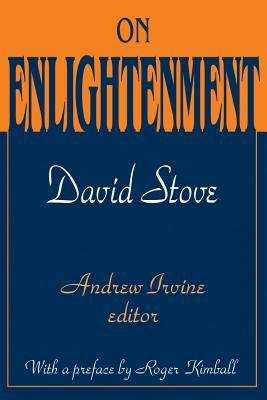
David Stove's On Enlightenment (2002) is a collection of his articles. While Stove is your typical Enlightenment materialist, he is never boring and is a rare independent thinker, daring to pursue issues and lines of thought that few other moderns/atheists would look into. Stove is a paradox. I'd be tempted to label him a progressive/conservative, but I'm not sure he'd like the moniker. He reminds me somewhat of the MacPhee character in CS Lewis' sci-fi novel, That Hideous Strength. One biography of Stove mentions:
During his childhood he had been associated with Presbyterianism, but in his teens he became an atheist and, as far as is known, never again espoused any religious belief whatsoever (although, curiously, he retained a lifelong interest in patristic theology, in which he was well read).[1]
In chapter 1, entitled Did Babeuf Deserve the Guillotine?[2], Stove examines the Enlightenment principle of equality and observes that while most Enlightenment principles had their source in Greco-Roman thinking this is NOT the case with principle of equality. He adds (2003: 12) “That everyone should be equal is a moral idea which simply never occurred to anyone in antiquity: not even to the most wide-ranging thinkers, such as Plato or Aristotle. Still less did the ideal of equality ever play any part in practical politics.” So what was the source of the egalitarian concept? Well if Stove has the reputation of an independent thinker, he immediately provides proof here and states (2003: 14)
As an actual force in history, the ideal of equality has its roots in Christian, not in classic, ground. There are plenty of passages in the Bible, of course, and especially in the New Testament, which point clearly to equality, and even to communism, as Christian ideals. There are plenty of similar passages in some of the early Fathers too. In fact, Christianity has always carried communism as a kind of "spare wheel," though, like all spare wheels, it is forgotten most of the time. For example, no one seems to remember that the blessed martyr St. Thomas More's Utopia (1516) is a communist tract. Again, it is forgotten that the most successful of the nineteenth-century American communist societies, such as the Perfectionists and the Shakers, were Christian ones. And so on.
But it had always been equally easy, of course, to assemble other Biblical passages, which point, equally clearly, in the very opposite direction; in the direction of submission to authority and acceptance of inequalities. And it was on this side that the whole weight of the organized church fell for a thousand years after Constantine adopted Christianity as the religion of the Roman Empire. Western Christendom, even more than Eastern, was essentially hierarchical, in every secular sphere as well as in every sacred one.
As a result, the seeds of egalitarianism were extremely slow in coming to fruition, even in Christian soil: they lay virtually dormant from 300 to 1300 A.D. But there had always been - and there always is - a certain number of people of the kind who, in Australia, are called "bush lawyers." Many of these people, in reading their Bibles, had made the amazing discovery that neither kings nor dukes nor bankers, neither bishops nor tithes, are things instituted by Christ. And the number of such people increased enormously with the spread of literacy, the translation of the Bible into vulgar tongues, and the invention of printing.
While Stove alludes to Christian communism there is a small matter he sweeps under the carpet. Christian communism (when it actually involved real Christians) was ALWAYS voluntary. It was no elitist ideology forced on the masses by the brutal power of the State[3]. Of course Stove is entirely right about the fact that for a thousand years the Church had buried the egalitarian principle. Emperor Constantine's adoption of Christianity sealed a process that had already begun before. By that point in time the Church was solidly under the influence of Greco-Roman thinking. Church administration became almost entirely modeled on that of the pagan Roman State, even borrowing many titles of office. Regarding this long period of rejection of equalitarianism by the Church, it is useful to realize that things might have turned out much differently had Jewish cultural influence in the Church, (very strong in the 1st century) had not been marginalized and eventually excluded in the following centuries. It is unfortunate that the (very hierarchical) Greco-Roman mindset soon became dominant. Though Stove does not openly credit the Reformation[4] as the source for the revival of the egalitarian principle in the West, in his comment below it is clear that this movement, which placed Scriptures in the hands of the masses, made a critical contribution in making the equalitarian principle commonplace (2003: 15)
Accordingly, egalitarian outbreaks began to occur as the late medieval world shaded into the modern one, and they became increasingly common and increasingly formidable. In the fourteenth century there were peasant revolts in France, Flanders, and England; in the fifteenth, there was the Taborite convulsion in Bohemia, and Jack Cade's revolt in England; sixteenth-century Germany saw the Peasants' War and the Anabaptist insurrection; and seventeenth-century England witnessed the movements of the Ranters, the Diggers, and the Levellers. These were increasingly explicit assaults on all privilege, and they all had an explicitly Biblical base. They were also, of course, all finally repressed; but only, except in Britain, with increasing difficulty and effusion of blood.
A philosopher of science not especially liked by Stove (Karl Popper) made a similar observation (Popper 1945/1962: 271)
I do not deny that it is as justifiable to interpret history from a Christian point of view as it is to interpret it from any other point of view; and it should certainly be emphasized, for example, how much of our Western aims and ends, humanitarianism, freedom, equality, we owe to the influence of Christianity. (...) What matters to Christianity is not the historical deeds of the powerful Roman conquerors but (to use a phrase of Kierkegaard's) what a few fishermen gave the world.
The Canadian Social Anthropologist Kenelm Burridge made a similar observation (1979: 188)
It should be remembered that Christianity as a political force started as a democratic and egalitarian movement and found acceptance, as it does today, among slaves, outcasts, and the disfranchised over against established hierarchies. Moreover, Christianity itself is subject to the same dialectic. If, over the years, established denominations have frequently had to come to terms with and surrender to restrictive and hierarchical political forms, European and Western democratic forms, we may remind ourselves, are not derived from Athens, which depended on forms of slavery, but from the modes developed by the Church and its religions orders. Millenarian and similar movements as well as reformist movements within the Church itself have always started by emphasizing egalitarian and democratic forms. Their later corruption and betrayal is as endemic and necessary to the process as is Judas to the Last Supper.
One could add that the anti-slavery movement with William Wilberforce (1759-1833), was probably the culmination (and last gasp) of the egalitarian outbreaks in Europe discussed by Stove and also had clear Christian roots. In effect only the Christian West ever thought to abolish slavery. No other civilisation ever thought to do so. In the ancient world enslaving conquered peoples was the natural right of nations. And of course, enslaving conquered peoples helped write off the expenses of military campaigns. In the ancient world, the cry of the oppressed was largely ignored. If fate had subjugated them and pressed them into slavery; they had no choice but to submit. That was their fate. Christianity rejected both this concept of fate and the hierarchical principle, but it must be admitted that in the West, it took centuries for this influence to take hold. The most radical expression of this rejection of hierarchy was found in the Epistle to Galatians.
For ye are all sons of God, through faith, in Christ Jesus. For as many of you as were baptized into Christ did put on Christ. There can be neither Jew nor Greek, there can be neither bond nor free, there can be no male and female; for ye all are one man in Christ Jesus. (Gal. 3 : 26-28)
In the ancient world this rejection of hierarchy was shocking and offensive heresy. Celsus, the 2nd-century Roman philosopher, expressed his contempt for Christians precisely from this perspective (Anonymous ~178 AD/1830: 19-20)
What is said by a few who are considered as Christians, concerning the doctrine of Jesus and the precepts of Christianity, is not designed for the wiser, but for the more unlearned and ignorant part of mankind. For the following are their precepts: Let no one who is erudite accede to us, no one who is wise, no one who is prudent, (for these things are thought by us to be evil); but let anyone who is unlearned, who is stupid, who is an infant in understanding, boldly come to us[5], For the Christians openly acknowledge that such as these are worthy to be noticed by their God; manifesting by this that they alone wish and are able to persuade the ignoble, the insensate, slaves, stupid women, and little children and fools.
So in Celsus' view, Christianity was a religion for idiots and low-lifes. The hierarchical principle was so deeply ingrained in the ancient world (becoming a natural reflex) that the apostles had to radically challenge it in order for Christians to reject it. Here is how they dealt with it:
For if there come into your synagogue a man with a gold ring, in fine clothing, and there come in also a poor man in vile clothing; and ye have regard to him that weareth the fine clothing, and say, Sit thou here in a good place; and ye say to the poor man, Stand thou there, or sit under my footstool; do ye not make distinctions among yourselves, and become judges with evil thoughts? Hearken, my beloved brethren; did not God choose them that are poor as to the world to be rich in faith, and heirs of the kingdom which he promised to them that love him? But ye have dishonored the poor man. Do not the rich oppress you, and themselves drag you before the judgment-seats? Do not they blaspheme the honorable name by which ye are called? Howbeit if ye fulfil the royal law, according to the scripture, Thou shalt love thy neighbor as thyself, ye do well: but if ye have respect of persons, ye commit sin, being convicted by the law as transgressors. (James 2: 2-9)
So to break down the influence of the hierarchical principle, the apostles went so far as make discrimination between persons of different social status a matter of SIN. It is very likely that anything less would not have driven the point home... Now imagine the ancient world noble, used to getting preferential treatment everywhere he went, yet in a Christian meeting, getting no better treatment than a slave...
In chapter 2 (A Promise Kept by Accident) Stove examines a claim at the heart of the Enlightenment (2003: 29)
In this way the Enlightenment became committed to a certain promise, made to the human race at large: this was the promise that, by increasing knowledge, human happiness would be increased beyond all previous experience. In fact it would be nearer the truth to say that the Enlightenment became, by about the middle of the eighteenth century, identified with this promise.
It is a bit odd that Stove neglects to take this observation any further. Here is the thing. What he has described above is a Gnostic worldview, offering salvation by knowledge. Of course in the ancient world such esoteric knowledge was imparted by a series of rituals and initiations, perhaps somewhat along the lines of the Scientology sect, with a price to be paid every step along the way. Since the Enlightenment however, the sacred knowledge is imparted by university studies. It is this claim that drives the elitist technocracy mindset. The technocrat is the new Philosopher-King. It is indeed odd that Stove did not connect these dots; particularly as a philosopher he must have encountered works by Gnostic thinkers.
The “increasing knowledge lead to human happiness” claim raises a number of issues. This is a matter that the British literary critic (and secular Jew) George Steiner puzzled over. In his essay Grammars of Creation (2001: 4-5), Steiner attempted to sort out the heavy issue of the WHY question of two world wars and the Holocaust. Clearly the twentieth-century, as far as Europe and Russia was concerned, was not heaven on earth, but rather hell. Steiner notes that between August 1914 and the Balkan wars of the 1990s more than 70 million people died. While the First World War inaugurated mechanized massacres, the Second introduced industrial extermination operations while the next generation experienced the terror of nuclear incineration. Obviously, wars, pestilence and famine are not phenomena unique to the twentieth-century. Such things have happened before. Steiner observes that the disintegration of humaneness in the 20th century bears a certain mystery. Steiner reminds us that this decay is not the result of barbarian invasions or external threats. As he points out Nazism, fascism and Stalinism all emerged from the social and administrative context of Western intellectual institutions and power centres. In the case of the Nazi Final Solution, there is a singularity, not in terms of scale, as Stalinism killed more people, but in terms of motivation. Nazis decreed that there was a class of individuals, including women and children, whose crime was simply to exist. The West has a dark side, but detecting its source seems problematic.
Steiner notes that the twentieth-century European disaster included a peculiar feature, it caused a regression of civilization. The Enlightenment confidently predicted the end of torture by legal authorities and decreed that the revival of censorship, book-burnings and that even the burning of dissidents or heretics was inconceivable. The nineteenth-century took for granted that the development of education, accumulating scientific knowledge and increased opportunities to travel would bring an inevitable improvement of public and private morality as well as greater tolerance of political views. Each of these hopes proved false. The First World War produced a preliminary shock, a great disillusionment for the generation that lived through it, but it was a small matter if one considers what was to come... Steiner points out that one must recognize that education had actually shown itself unable to nurture compassion or resistance to the logic of hatred. But it is shocking to see that a culture as refined and as advanced in artistic, scientific and intellectual terms as that of early 20th century Germany collaborated so readily and actively with the sadistic ideology of the Nazi State. It turns out that technocratic engineering may efficiently assist or remain indifferent to the call of the inhumane. The Modern worldview clearly offers no intrinsic obstacle to such temptations. In this regard, French biologist P.-P. Grassé noted (1980: 44):
After the [1933] triumph of National Socialism, German science provided massive unconditional backing to the Führer. Anthropologists, geneticists, economists and lawyers began zealously serving their new master. [Grassé adds in a footnote at the bottom of the page [2] – PG]: German intellectuals' support to their Führer was substantial. During the 1933 referendum, statements by university professors were collected in one volume. Among the authors of these texts one encounters the famous philosopher Martin Heidegger, which is both surprising given the idealism that permeates his work and revealing of the mind-set that gave Hitler such a victory.*
There is further evidence in the fact that of the 15 Nazi officials who attended the January 1942 Wannsee Conference which set up the Final Solution extermination program, eight held doctorates[6] and others were university educated. These were not street thugs as were many in the Nazi Brown Shirt paramilitary organisation. Most of these attendees were lawyers. The basic issue here is that the Enlightenment “increasing knowledge lead to human happiness” claim failed spectacularly in the 20th century.
Again in chapter 2 Stove offers an odd defence of religion (doesn't mention Christianity). As he discusses reactions to David Hume's writings he makes the following observation (2003: 34)
Hume, for example, ignored the following response by James Beattie to his attacks on religion. People like Hume, Beattie wrote, should remember that "in the solitary scenes of life, there is many an honest and tender heart pining with incurable anguish, pierced with the sharpest sting of disappointment, bereft of friends, chilled with poverty, racked with disease, scourged by the oppressor; whom nothing but trust in Providence, and the hope of a future of retribution, could preserve from the agonies of despair. And do they [the Enlightened], with sacrilegious hands, attempt to violate this last refuge of the miserable, and to rob them of the only comfort that had survived the ravages of misfortune, malice, and tyranny!"
After this quote Stove basically agrees with Beattie and observes that Hume never bothered to answer Beattie's argument. The background issue driving Stove's thinking here is not clear, but would appear to an implicit admission of the bleakness and hopelessness of an entirely materialistic worldview. The key issue would appear not to be it's effect on a Christian, but it's effect on an Enlightenment believer. The French philosopher Albert Camus once famously expressed this in the following blunt manner (1942/1991: 3)
There is but one truly serious philosophical problem, and that is suicide. Judging whether life is or is not worth living amounts to answering the fundamental question of philosophy. All the rest — whether or not the world has three dimensions, whether the mind has nine or twelve categories — comes afterwards. These are games; one must first answer [the question of suicide].
The materialistic origins myth (theory of Evolution) which found its place at the core of the mature phase of the Enlightenment basically tells its devotees: “The Utter (and indifferent) Void gave you birth, and the Darkest Abyss is your final destiny”. As Camus points out this is the extraordinarily personal and existential question. When one is forced to walk in what Christians call the Valley of the Shadow of Death, where all you may have built up over your life is raised to the ground or else hangs by a thread, then the temptation of despair can become an insurpassable physical obstacle. Such matters may have played a part in Stove's last chapter...
In chapter 3 (The Bateson Fact) we run into a dark side of Stove's views as he seems to offer a subtle defence of eugenics..
In chapter 8 (entitled Altruism and Darwinism) Stove examines ethical issues in the Enlightenment/Modern worldview. Since ethics are inevitably grounded in a worldview's origin myth, one must look into the ethical implications of the materialistic origins myth (the theory of Evolution). To figure this out, the starting point is that Evolution's primary mechanism for progress (materialist salvation...) is the concept of the Survival of the Fittest. This a raises a huge marketing problem as Darwinism would appear to encourage the kind of ruthless behaviour the Nazis exhibited towards anyone they considered their enemy or inferior. Human altruism would then be views and anti-evolutionary. As a result more consistent Darwinists, such as the Social Darwinists or Sociobiologists such as EO Wilson, would dismiss human altruism not as a refutation of the Survival of the Fittest principle, but only as an illusion.
In this chapter, Stove discusses the views of Darwin's Bulldog, Thomas Huxley. Huxley was of course aware of the huge marketing issue that the Survival of the Fittest principle raised for Evolution. It boils down to this: Brutal selfishness is the only real ethical principle you can directly derive from the Theory of Evolution. This is true because it has roots in a core evolutionary concept: the Survival of the Fittest mechanism, which is the driving force of Evolution. This is the mechanism we are told that has produced amoebas, bumble bees, sequoias, blue whales, trumpeter swans, elephants, polar bears and humans. So, logically, why should it not also provide us with our ethics and morality? Huxley's solution to this problem was a word-game, that is conveniently roping in altruism as a “survival mechanism”. Regarding such views Stove points out the inconsistency and bluntly observes (2003: 136)
Although these late essays of Huxley were discreditable, in fact disgraceful, to his head, they were creditable to his heart. He got himself into the ludicrous position he did because his nostrils had rightly detected the power-worship latent in Darwinism, whereas what he wanted was Darwinism-with-decency; Darwinism without social Darwinism, Darwinism which does not promise success and give honorific titles to people distinguished mainly by their talent for trampling other people down. This is also what nearly every educated person nowadays wants, as I said near the start of this essay. Huxley was simply the first of us.
It is another question, of course, whether it is logically possible for us to have what we want. I have indicated earlier that I believe it is not. Darwinism is false if man is now exempt from natural selection. It is false again, if natural selection is not everywhere dependent upon ruthless competition for survival. The social Darwinist concludes, with consistency on his side, that human altruism is a delusion. But a rational person will conclude, with equal consistency and far more credibility, from the obvious fact of human altruism, that Darwinism is a delusion. If you are determined to have Darwinism and decency, then your position will be essentially that of Huxley in 1893: evolution-and-selfishness for the brute creation, and ethics-and-altruism for us. But then you have exempted man from natural selection, and thereby abandoned Darwinism.
So basically Stove is saying that human altruism refutes the materialistic origins myth. The German philosopher Nietzsche openly despised initiatives such as Huxley's. In his 1889 essay Twilight of the Idols (ix.5), Nietzsche cynically remarked:
G. Eliot. They are rid of the Christian God and now believe all the more firmly that they must cling to Christian morality. That is an English consistency; we do not wish to hold it against little moralistic females à la Eliot. In England one must rehabilitate oneself after every little emancipation from theology by showing in a veritably awe-inspiring manner what a moral fanatic one is. That is the penance they pay there.
We others hold otherwise. When one gives up the Christian faith, one pulls the right to Christian morality out from under one's feet. This morality is by no means self-evident: this point has to be exhibited again and again, despite the English flatheads. Christianity is a system, a whole view of things thought out together. By breaking one main concept out of it, the faith in God, one breaks the whole: nothing necessary remains in one's hands. Christianity presupposes that man does not know, cannot know, what is good for him, what evil: he believes in God, who alone knows it. Christian morality is a command; its origin is transcendent; it is beyond all criticism, all right to criticism; it has truth only if God is the truth _ it stands or falls with faith in God.
When the English actually believe that they know 'intuitively' what is good and evil, when they therefore suppose that they no longer require Christianity as the guarantee of morality, we merely witness the effects of the dominion of the Christian value judgment and an expression of the strength and depth of this dominion: such that the origin of English morality has been forgotten, such that the very conditional character of its right to existence is no longer felt. For the English, morality is not yet a problem.
Oddly enough CS Lewis made observations rather comparable to Nietzsche's. In his autobiography (Surprised by Joy), Lewis remarked that shortly after WWI when he began his university studies little had changed since Nietzsche's initial observations (1955: 209-210)
But there were in those days all sorts of blankets, insulators, and insurances which enabled one to get all the conveniences of Theism, without believing in God. The English Hegelians, writers like T. H. Green, Bradley, and Bosanquet (then mighty names), dealt in precisely such wares. The Absolute Mind — better still, the Absolute — was impersonal, or it knew itself (but not us?) only in us, and it was so absolute that it wasn't really much more like a mind than anything else. And anyway, the more muddled one got about it and the more contradictions one committed, the more this proved that our discursive thought moved only on the level of "Appearance", and "Reality" must be somewhere else. And where else but, of course, in the Absolute? There, not here, was "the fuller splendour" behind the "sensuous curtain". The emotion that went with all this was certainly religious. But this was a religion that cost nothing. We could talk religiously about the Absolute: but there was no danger of Its doing anything about us. It was "there"; safely and immovably "there". It would never come "here", never (to be blunt) make a nuisance of Itself. This quasi-religion was all a one-way street; all eros (as Dr. Nygren would say) steaming up, but no agape darting down. There was nothing to fear; better still, nothing to obey.
Stove has an enviable knack for puncturing holes in Enlightenment tropes. For example in chapter 10 he calls out a standard Enlightenment propaganda point (2003: 149)
There has only ever been one very general argument for anti-conservatism, as far as I know, and it is not a good one. But it is one which has been so widely thought good that hardly anyone in the last 150 years, touched at all by education, can have entirely escaped its influence. I call it the "'They All laughed at Christopher Columbus' Argument," and for short "the Columbus argument." It goes as follows: "Throughout almost all of human history, people who have opposed innovations, whether in belief or in behavior, have met with hostility. Death, or persecution, or prison, or at best neglect, has been the regular reward for their efforts. Yet whatever improvements have actually been made in human life, either in our opinions or in our practice, have depended, and must always depend, on some innovator in the first place. We ought, therefore, not merely to tolerate, but to welcome, innovators."
Here's the thing, those constrained by the logic of such an argument, would necessarily have to welcome Hitler as he clearly innnovated in regards to methods of massacering humans. Shouldn't we welcome ALL innovators? Why bring in other ethical concerns? Nietzsche‘s comments above come into play here as well. Stove mops up the Columbus argument in the following satisfying fashion (2003: 151)
How did an argument so easily answered ever impose upon intelligent people? Easily. It was simply a matter of ensuring what Ludwig Wittgenstein (in another connection) called a one-sided diet of examples. Mention no past innovators except those who were innovators-for-the-better. Harp away endlessly on the examples of Columbus and Copernicus, Galileo and Bruno, Socrates and (if you think the traffic will bear it) Jesus. Conceal the fact that there must have been at least one innovator-for-the-worse for everyone of these (very overworked) good guys. Never mention Lenin or Pol Pot, Marx or Hegel, Robespierre or the Marquis de Sade, or those forgotten innovators of genius to whom humanity has been indebted for any of the countless insane theories which have ever acquired a following in astronomy, geology, or biology. There is no weakness in the Columbus argument which cannot be more than made up for by a sufficiently tendentious choice of examples.
Rewording Stove's argument slightly, you could say that with a sufficiently biaised data-set, you can prove any nonsense statement...
Chapter 12 (Jobs for Girls) describes efforts at implementing affirmative action in Stove's university. Stove claimed there never was any discrimination specifically targeting women and these affirmative action initiatives would only insure hiring incompetents (seeing previously merit was the basic hiring criteria). No doubt his response earned him many enemies. Perhaps I should join him. I distinctly remember Québec university campuses in the late 1970s with activists going around protesting the fact that there were less women tha men in Medicine and Engineering and fighting (so they told us) “For Justice and Equality”. Yet now that women are a clear majority in Medicine, where are these fighters for “For Equality” and Justice? Gone with the Wind apparently, nowhere to be found. Only one thing is clear now, it never was about equality or justice...
In chapter 13 (Why You Should be a Conservative) Stove explores how a perverted sense of morality (which Stove vaguely labels benevolence, whatever that means) is the driving force behind a totalitarian ideology such as communism. By benevolence Stove apparently means a concept of the human solely in the abstract (taking humanity as a whole as its object), which then becomes a dehumanized morality totally disconnected to the welfare of individual human beings (2003: 173)
A person who is convinced that he has a moral obligation to be benevolent, but who in fact ranks morality below fame (say), or ease; or again, a person who puts morality first, but is also convinced that the supreme moral obligation is, not to be benevolent, but to be holy (say), or wise, or creative: either of these people might turn out to be a scourge of his fellow humans, though in most cases he will not. But even at the worst, the misery which such a person causes will fall incomparably short of the misery caused by Lenin, or Stalin, or Mao, or Ho Chi Minh, or Kim I-Sung, or Pol Pot, or Castro: persons convinced both of the supremacy of benevolence among moral obligations, and of the supremacy of morality among all things. It is this combination which is infallibly and enormously destructive of human happiness.
The free world's trouble is that this lethal combination is by no means peculiar to the communists. On the contrary, it is shared by those Enlightenment utopians who (as I was saying earlier) are the de facto rulers of the free world, and have been so for more than twenty years. These people, of course, are not communists, if only because they have never yet made even that intellectual advance which (as I said) separates Marx's "scientific socialism" from "utopian socialism." But they are, for the reason I have just mentioned, almost as dangerous as the communists.
I would disagree with Stove's last point as in my view, the neototalitarians presently running the West (what Stove calls those Enlightenment utopians) are in fact more dangerous than the communists simply because they are more manipulative (as opposed to openly brutal) and more hypocritical. These neototalitarians have a much better grasp of how to use marketing techniques as they push their concept of benevolence. In this regard they are light-years ahead of 20th century totalitarians. However Stove is quite right that not only communists share the totalitarian urge, the thirst for Absolute power. In 2026 there are new spins on this old thirst and plenty of mind-boggling technology that it can play with.
C. S. Lewis understood aspects of this totalitarian urge as in his sci-fi trilogy, specifically Out of the Silent Planet (chap. 20), there is a long rambling, unquotable, conversation between Oyarsa, the planetary spirit and Weston, the heartless scientist/ideologue, where Weston propounds this specific concept of the human solely in the abstract, which he sees mercilessly advanced while trampling over the corpses of millions of intelligent beings. When Stove talks about a concept of the human solely in the abstract in his Abolition of Man CS Lewis labelled such ideologues promoting such ideas the Conditioners and examined the moral reasoning behind their mindset (1943/2014: 32)
To some it will appear that I am inventing a factitious difficulty for my Conditioners. other, more simple-minded, critics may ask, ‘Why should you suppose they will be such bad men?' but I am not supposing them to be bad men. They are, rather, not men (in the old sense) at all. They are, if you like, men who have sacrificed their own share in traditional humanity in order to devote themselves to the task of deciding what ‘humanity' shall henceforth mean. ‘Good' and ‘bad', applied to them, are words with-out content: for it is from them that the content of these words is henceforward to be derived.
In the God in the Dock collection of articles Lewis compared the old oppressors to the new who have stepped into the moral vacuum of the Conditioners, boldly exploring New Worlds... (1947/2002: 292)
Of all tyrannies, a tyranny sincerely exercised for the good of its victims may be the most oppressive. It may be better to live under robber barons than under omnipotent moral busybodies. The robber baron's cruelty may sometimes sleep, his cupidity may at some point be satiated; but those who torment us for our own good will torment us without end, for they do so with the approval of their own conscience.
While the Why You Should be a Conservative article was originally published in 1988, I have no reason to expect Stove ever read any CS Lewis, nor was influenced by him.
Anonymous (~178 AD/1830) Arguments of Celsus, Porphyry and the emperor Julian against the Christians... Thomas Rodd, London 116 p.
Burridge, Kenelm (1979) Someone, No one: An Essay on Individuality. Princeton U. Press Princeton NJ 270 p.
Camus, Albert (1942/1991) The Myth of Sisyphus: And Other Essays. Vintage New York 224 p.
Gosselin, Paul (1979) Myths of Origin and the Theory of Evolution. (Samizdat)
Gosselin, Paul (1926) Postmodernism as a Worldview: A nutshell perspective. (Samizdat)
Grassé, Pierre-Paul (1980) L'Homme en accusation: De la biologie à la politique. Albin Michel Paris 354 p.
Lewis, C. S. (1943/2014) Abolition of Man: Reflections on education With Special Reference to the Teaching of english in the Upper forms of Schools. Samizdat – 49 p.
Lewis, C. S. (1947/2002) God in the Dock. (Walter Hooper ed.). Eerdmans Grand Rapids MI 347 p.
Lewis, C. S. (1955) Surprised by Joy. Harcourt Brace Jovanovich New York Ebook
Nietzsche, Friedrich (1895) Twilight of the Idols. (translation by Walter Kaufmann and R.J. Hollingdale)
Popper, Karl R. (1945/1962) The Open Society and its Enemies. Routledge & Kegan Paul London vol. 2
Steiner, George (2001) Grammars of Creation. Yale University Press New Haven 347p.
Stove, David (2003) On Enlightenment. [Andrew Irvine (editor), Roger Kimball (preface)] Transaction Publishers New Brunswick NJ 185 p.
[1] - The same biography sadly observes that Stove took his own life in 1994 after suffering from throat cancer.
[2] - Oddly enough, it takes a while before Stove gets around to discussing Babeuf, the French revolutionary.
[3] - This is something Stove fully recognizes and regarding Enlightenment-influenced attempts to implement equalitarian principles in real social contexts he bluntly exposes the typical outcome of such attempts (2003: 19)
Can you believe that it is an accident that the progress of egalitarianism, for the last two hundred years, has almost everywhere been a progress through deeper and ever-deeper oceans of blood? (Think of France in 1789 and 1871, Russia in 1917, China in 1948, South Vietnam in 1968, Cambodia in 1976, etc.) Again, can you believe that it is an accident that the quantity of blood spilt by egalitarian governments in our century dwarfs into insignificance all the blood ever spilt by clerical, aristocratic, or capitalist "reaction"? For my part, however hard I try, I cannot believe that either of these facts is accidental.
[4] - As well as a few pre-Reformation movements such as the Waldensians (or Vaudois) and the followers of John Wycliffe and Jan Hus who placed Scripture above Church authority.
[5] - Which is a parody of the following verses
Because the foolishness of God is wiser than men; and the weakness of God is stronger than men. For behold your calling, brethren, that not many wise after the flesh, not many mighty, not many noble, are called: but God chose the foolish things of the world, that he might put to shame them that are wise; and God chose the weak things of the world, that he might put to shame the things that are strong; and the base things of the world, and the things that are despised, did God choose, yea and the things that are not, that he might bring to nought the things that are: that no flesh should glory before God. (1Cor. 1: 25-29)
[6] - Wiki notes that one Wannsee attendee, Alfred Meyer was a Freemason.